Many statistical studies confirm that most uses of most popular investment strategies just don't work consistently. So we don't use them. Some comments, and links to solid studies on these issues. As a result, as Barry Ritholtz argues statistically, 90% of all investement products are crap! -- mutual funds, SPACs, hedge funds, private equity, ETFS - few beat benchmarks (such as the SPY) net of fees over a long-term investment horizon (5 to 10 years +). And one reason most go-long investment products are crap is that most patents (innovations that can produce alpha-returns) are crap, leading to: ▸ from 1926 through 2025, just 27.6% of stocks beat the broader market. Nearly 60% actually destroyed shareholder wealth, and the median stock delivered a lifetime return of -6.9%. A lot of CEOs replaceable with an AI CEObot.
BUT FIRST, IS IT ALL RIGGED?
Even assuming there exists financial trading techniques that work in theory, worked in the past, etc. - something worth putting your money into - something you put a lot of your smarts into - is it all rigged? Here is one lament:▸ QTR's Fringe Finance, 12 July 2026A couple of months ago I wrote that I had stopped actively trading, stopped sports betting, quit fantasy football and the likes. I also spoke out against the culture of gambling taking over our country. The reason? In short, it is all fucking impossible to predict, there is always going to be sharper money with better leans on short term bets. Whether its massive 0DTE puts coming in on oil before the next ceasefire announcement, or someone seeing Conor McGregor limping into the ring and knowing he already had a leg injury last night before his fight, the rigging of both sports and financial markets is now beyond obvious. .... Then there are central banks, governments and policymakers distorting markets to the point where fundamentals feel/are irrelevant. [Trading has become a casino]: monetize attention by keeping people emotionally activated every waking minute of the day. People celebrate that you can trade cryptocurrencies 24/7. That is a bug, not a feature.
CAN BE USEFUL
HIGH PROBABILITY HISTORICAL TRADES
There are a variety of historical trades that have good track records across the decades. For example, Jeffrey Hirsch in his ▸ Stock Trader's Alamanac (an excellent buy) has or many years described the January effect - the rise or fall of the SP500 in January is mostly in the same direction of the rise and fall by year end, with good enough average returns to make relying on AI superfluous. A similar effect is seen in the direction of the first five days of January. Another involves mid-term elections. We provide a spreadsheet of data back to 1950 for you to play with: ▸ Spreadsheet of high probability historical trades.
PREDICTION MARKETS
There are some useful sources of economic investment advice. One such potential useful source is prediction markets. The Federal Reserve has a January 2026 paper, which conclude: ▸ Our results suggest that Kalshi markets provide a high-frequency, continuously updated, distributionally rich benchmark that is valuable to both researchers and policymakers. "We have shown that Kalshi-implied distributions are well-behaved, responsive to news, and comparable in forecasting accuracy to established benchmarks such as the Survey of Market Expectations and the Bloomberg consensus. In several cases, they provide unique insights -- particularly for variables like GDP growth, core inflation, unemployment, and payrolls, for which no other market-based distributions currently exist.
PROBABLY NOT USEFUL
Note: if all of the below is confusing, that's what the financial world is today.
THE 60 (stocks) / 40 (bonds) PORTFOLIO
A long time philosophy, probably no more. One article arguing this: ▸ The 60/40 portfolio died years ago. August 2026 (Apollo Global): The 60/40 portfolio is broken because equity returns are driven by AI concentration rather than the business cycle, while bond returns are now driven by fiscal constraints rather than cycle dynamics.
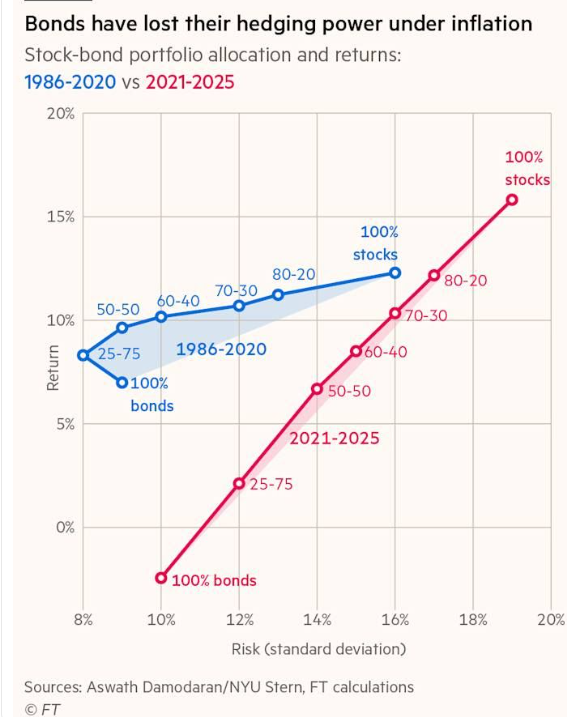
Graph from: ▸ Bonds are not doing their job, Trendlabs, 31 August 2026.
(UN)PROFESSIONAL MONEY MANAGERS / EQUITY FUNDS
August 2026:
▸ Stock-picking funds are performing as poorly as ever -
just 13% of USA large-cap funds have outperformed indexes over the past
decade, new data show. Despite the huge AI bubble in the stock markets,
just 27% of actively managed U.S. large-cap equity funds beat their benchmark passive-fund alternatives in the 12 months ended June 30.
▸ Standard & Poors publishes an annual report on the performance of
money managers, at least for active large-cap USA equity funds. For
25 years, in each year, the majority of these money managers underperformed
the SP500, with 79% underperforming in 2025, the fourth-worst performance in
25 years. Most money managers of other types of funds: Mid-Cap, Small-Cap,
International - also underperformed their respective indexes. And those
funds that outperformed the indexes relied much on the AI bubble (which
managers should get no credit for). Money managers replaceable with
MoneyManageBots.
ETF.com, 24 June 2026 warning article:
▸ Are thematic ETFs a $300 billion trap for everyday investors?.
These specially-designed (by money managers) ETFs have problems: over 60%
of thematic ETFs have a Sharpe ratio below 1.0, meaning most aren't
delivering strong risk-adjusted returns despite their popularity among
investors seeking exposure beyond benchmark heavyweights.
Larry Swedsoe has an article:
The seven sins of active fund management/[managers]:
many are poor forecasters, rely too much on too much [useless] information,
meeting with companies they invest in, thinking they can do better than the
average fund manageer, short time horizons and overtading, believing
everything they read [note: one reason Kukaxoxo Finance is building
probability models of lying that affects investments], and group decision
making at investment firms.
INCOME FROM GAMBLING/PREDICTIONS
The latest investment scam is the lure of riches from sports gambling
and prediction markets, which starting in the 2020s, addicted millions of
(young) idiots. As of June 2026 over $45 billon was wagered on two
platforms, Kalshi and Polymarket. How idiotic? The top 1% of gamblers
earn in the low-five figures. "Betting on a salary equivalent to a
part-time job's wages isn't a wise decision to plan one's retirement
around." 26 percent of Gen Z people consider sports gambling as part of
their retirement investment plans. From:
Never attempt to dollar cost average a coin flip, by Anthony Isola's
"A Teachable Moment", September 2026.
FUNDAMENTAL ANALYSIS
Between ETFs inflows/outflows, pension rebalancing, random political
disruptions, nonsense economics such as EBITDA and non-GAAP, socialist
subsidies, yet-to-be-convicted corporate crimes, meme stock squeezes by
gaming retail tradeers, and the Federal Reserve's 'cocaine' (rate cuts)
or 'cold turkey' (rate hikes), fundamental analysis just is not that
useful anymore, more for providing entertainment on CNBC and Bloomberg.
Read Barron's for inspiration.
Yahoo Finance has a neat article:
▸ 3 brilliant quotes on the challenge of valuing companies, a
classic aspect of fundamental analysis:
Some articles:That is a lot of assumptions that you are making.
Yeah, absolutely. What choice do I have?
Do you know what the biggest intangible is? Future growth.
It is like having a kindergartner's report card and extrapolating
from that what they will be doing in college.
- When retail capital flow overwhelms institutional fundamentals. (CFA Institute, 18 September 2026). Retail-driven capital flows have increased substantially over the last five years and are now a persistent feature of market structure. These flows have the potential to amplify volatility over short periods and create a durable source of market risk. An analyst can be right about a company, and the position can still lose money because, under certain conditions, retail flow can overwhelm traditional price discovery for weeks, even months, at a time.
- The Math of Investment Success is Brutal - (A Teachable Moment, 16 September 2026). In an analysis of every US stock listed from 1926-2016, it was shown that" of the top 1000 top-performing stocks, less than 4% of the total accounted for all the wealth creation in the market. The remaining 96% of stocks matched the returns of risk-free Treasury Bills. The majority of stocks, 51.6% had negative returns over their lifespan. So why bother with fundamental analysis? " The golden rule for the mass majority of investors is understanding that nobody knows in advance the stock market's eventual winners." [or can determine with fundamental analysis].
- Warren Buffett on the stock market today: "It is tough to find [fundamental] values when everybody is preferring to gamble". (CNBC, 15 July 2026)
- "An absolute casino": the $500 billion leveraged and inverse ETF craze proving Buffett right (24/7 Wall Street (@ YF), 13 July 2026). For example, leveraged ETF rebalancing drove Micron down 5% and SanDisk down 9% on quiet news days, despite positive fundamentals where both companies posting consecutive earnings beats. Leveraged ETFs must rebalance at the end of each session to maintain their target multiple, making them mechanical forced buyers into rallies and forced sellers into declines - making the fundamentals irrelevant. "It is an absolute casino. The only thing missing is Siegfried and Roy."
- What good is fundamental analysis based on P(rice)/E(arnings) ratios, if you can't trust the E - earnings? (Wall Street Journal (locked), 13 July 2026). Past earnings are not necessarily predictive of future earnings, and future earnings predictions are dart-throwing and tea-leaf reading.
- ETF rebalancing is now an unignorable source of instability for stock prices, making fundamental analysis more meaningless (Zero Hedge (locked), 30 June 2026).
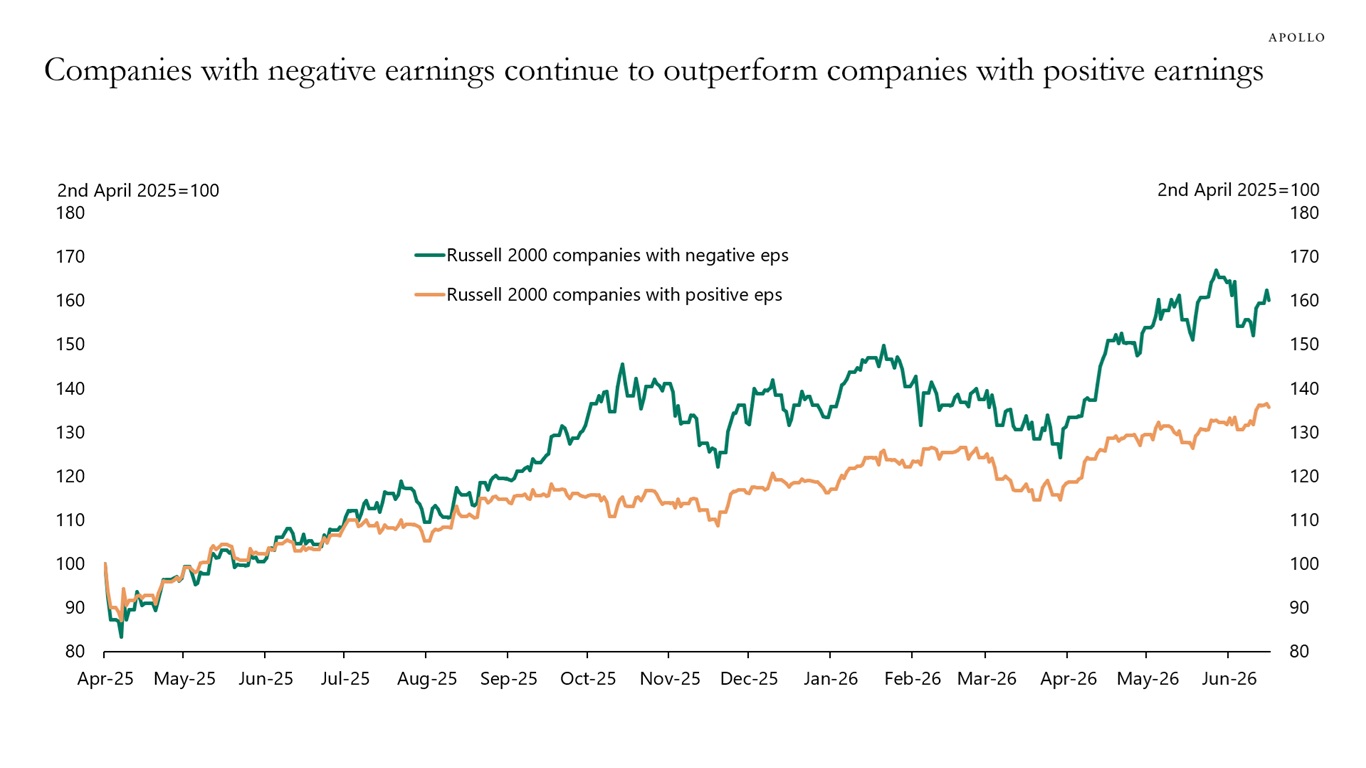
- Russell 2000 companies with negative EPS (a fundamental indicator) are outperforming Russell 2000 companie with postive EPS? - Apollo Global, 20 June 2026. To quote Apollo: "Something is broken in price discovery when companies with negative earnings keep outperforming companies with positive earnings."
- 9 of the stock market's 10 most-watched valuation indicators are now in 'sell' territory - Mark Hulbert, Morningstar, 24 February 2026. This illustrates the difficulty of using fundamental indicators such as the CAPE ratio, P/E ratios, money supply, dividend yied, etc. With 9 of 10 indicators in the 'sell' territory, and the 10th close enough, you would think, "SELL EVERYTHING AND GO SHORT". But in a bubbled market, how useful are fundamental indicators?
- The myth of the stock-picker's (fund managers) markets - Amy Arnott, Morningstar, 21 October 2025. For the last ten years, the SP500 each year has outperformed an average of 70% of actively managed equity funds that use the SP500 as a benchmark. Morningstar's Active/Passive Barometer study has consistently found that few actively managed funds have fared better than a composite made up of passively managed funds. That is particularly true in the large, liquid areas such as US large-cap stocks.
- Why your stock and bond index funds outsmart the best and brightest on Wall Street - Mark Hulbert, MarketWatch, 18 October 2025. Colleges and universities in the USA would collectively be $468 billion richer, if 20 years ago they had fired their 'fundamentals' investment managers and just bought indexed ETFs.
- Corporate stock buybacks are the worst use of corporate cash, and are a benefit that almost entirely benefits corporate insiders. - Lance Roberts, Real Investment Advice, 16 May 2025
- The rise of the Ponzi ETF - Joachim Klement (substack), 21 November 2024. Lots of money chasing illiquid stocks in ETFs means their share prices rise, not because of fundamentals but because of a lack of supply. This in turn creates stronger performance for thematic ETF. Themes with strong performance attract media attention and investor attention. If there are enough investors that find the theme attractive, more money will flow into the ETF and the underlying stocks, pushing prices even higher. Thus is created a Ponzi scheme where new investors pay for the gains of previous investors. When the flows end, the Ponzi scheme collapses.
- No alpha (i.e., beating a relevant index) left in the public stock markets - Torsten Slok, Apollo Global Management, 9 September 2025. "Combined with the domination of passive investing, failure of active managers to beat indexes, and high correlation in public markets, and high concentration in a few [bubbled] stocks, the reality is that there is no alpha left in public markets." So no point in doing fundamental analysis.
- How index funds are ruining small-cap investing - Barron's, 23 July 2025. This cites the following:
- Why diversification is failing in the age of passive investing - Lance Roberts, Real Investment Advice, 08 September 2025. "Monetary and fiscal interventions, global central bank interest rate policies, the maturity of algorithmic and computerized trading strategies, and concentration have reduced the value of diversification. As shown, any portfolio 'diversified' between large, mid, and small-cap stocks, international and emerging markets, real estate, and gold, has significantly underperformed being invested solely in the S&P 500 index. "The assumptions that supported MPT, uncorrelated assets, stable relationships, and rational price behavior, have eroded. Central banks have injected liquidity, distorted yields, and suppressed volatility. Meanwhile, passive investing has reshaped how money flows into stocks." So why bother with fundamental analysis to figure out how to diversify?
- The rise of Ponzi ETFs - Joachim Klement, November 2024. How thematic ETFs create bubbles in niche corners of the market. If a niche/theamtic ETF attracts investor money, it must invest this money into the few illiquid stocks it holds. Lots of money chasing these illiquid stocks means their share prices rise, not because of fundamentals but because of a lack of supply. This attracts more attention and investors, pushing up prices. We have created a Ponzi scheme where new investors pay for the gains of previous investors, fundamentals be damnded.
- Passive investing and the rise of mega-firms - Jiang, Vayanos, Zheng, March 2025. "... prices and idiosyncratic volatilities of the largest SP500 companies rise the most following flows into that index ...", i.e., fundamentals don't matter.
- Jim Cramer: from 2001 to 2017 his picks underperformed the SP500 - Murrary Coleman, Index Fund Advisors, 28 November 2021. Cramer is the king (clown) of fundamental analysis with his CNBC show "Money Money". Not beating the SP500 for decades is not a testament to fundamental analysis.
- "Whatever the level and whichever flavor you prefer, price-to-earnings ratios say little about the markets' future direction. Trailing P/Es, based on past performance, are too backward looking. Forward P/Es, based on predictions such as analysts' estimates rely somewhat on the past as well, and analysts' biases. "There is simply no level or trend where P/E ratios reliably indicate an upcoming bear or bull market."
- How to think about the stock market when earnings guidance becomes meaningless. (Wall Street Journal, 12 May 2025)
FUNDAMENTAL ANALYSIS - EBITDA
EBITDA - "Earnings Before Interest, Taxes (which includes tariffs), Depreciation and Amortization", an accounting scam slightly better than EBITDA-I - EBITDA before Income. EBITDA ignores critical costs, such as depreciation, which can distort a company's true economic picture in capital-intensive industries. When companies extend the lives of their assets to reduce depreciation expenses, EBITDA increases, even though the underlying cash outflows remain unchanged. If you rely only on EBITDA, you may miss the fact that the business is burning cash, depending on borrowing, or stretching asset lives unrealistically. More on the scam of EBITDA at: EBITDA and the warnings of Charlie Munger.
FUNDAMENTAL ANALYSIS - NON-TRANSPARENT COMPANIES
Citigroup announced a new platform for tokenized shares of private companies last week, describing it as a blockchain innovation. RED FLAG: If a private company's shares can increasingly trade like public securities, at what point should that issuer be required to provide public-company levels of disclosure? This is pure casino gambling. Enjoy it at your risk. But unless you are an insider, you will probably lose money.
VALUE INVESTING
From a Morningstart article: ▸ Is value investing dead?. "Value investing and its followers have struggled over the past two decades. That might be an understatement. The drought has lasted so long that some have understandably thrown in the towel." Value investing is built around a basic idea: Investors should buy stocks at a price below the value of their underlying businesses - a form of fundamental analysis. But determining the value of business is difficult. And what is determinable, everyone now has access to that information, so no profit edge.
LOSING PUBLIC PENSION FUND STRATEGIES
Real Clear Markets, 25 June 2026, has another example of failed investment strategies: ▸ The actuarial fiction hiding $5 trillion in public pension debt. Public pensions hide $5 trillion in debt by assuming that they can earn 7.0% a year with investments, while properly funded corporate pension funds only assume a return of 5.6^% a year. 86% of public plans assume returns above their own 23-year average. Over the past 20 years, 84% failed to beat a passive 60/40 portfolio, which delivered 7.9% annually against the public plans' average of 7.5%. Every plan in the sample trailed the S&P 500 over the same period, which returned 10.4%. Which, I suppose, creates the counter-strategy - whatever a public pension fund invests in, do the opposite.
TECHNICAL ANALYSIS
Most technical analysis techniques, especially moving averages, look good in articles and books on trading systems. But rigorous statistical analysis reveals most are not that profitable, as compared to just buying the SPY or GLD. Some articles:
- A value-weighted version of the CAPE ratio corrects a structural flaw and delivers stronger forecasts of long-term stock returns - by Larry Swedroe, Morningstar, 09 September 2026. The Schiller CAPE ratio is a hugely popular technical indicator, calculated by dividing the S&P 500 price level by the average of the past 10 years of total index earnings - an earnings-weighted average. But in this article, Swedroe argues a value-weighted average is more useful. This article is a good example of the complexity of using technical indicators.
- The Turtle Trading System doesn't beat generally increasing stock prices - by Kryptera, Medium (locked), 30 August 2026. The Turtle Trading System made some people a lot of money in the 1980s in the futures market, when technical analysis was young and you could make money with simplicity. The TTS, invented by Richar Dennis and William Eckhardt, was a trend following system based on buying at a 20/40/55-day high, and then exiting at a 10/20-day low, using Average True Range as well. Kyptera ran it on the SPY from 1993 to 2026 (Python code provided in the article) and achieved a return of 334% in the 33 years of trading the system. Not bad, but buy-and-hold of the SPY returned 3074%. Hard to be a mostly monotonically increasing stock traded with buy-and-hold (we discussed problems with buy-and-hold below).
- Technical analysis and individual investors [or managers] - by Arvid Hoffman and Hersh Shefrin, J. Economic Behavio & Organization. "We find that individual investors who use technical analysis and trade options frequently make poor portfolio devisions, resulting in dramatically lower returns that other investors."
- The predictive ability of technical trading rules: an empirical analysis of developed and emerging equity markets - by Kevin Rink, Financial Markets and Portfolio Analysis, August 2023 "We investigate the predictability of leading equity indices of 23 developed and 18 emerging markets with a set of 6406 technical trading rules over up to 66 years. ... Overall, our results cast serious doubt on whether investors could have earned any excess profits using the broad range of considered technical trading rules."
- Technical analysis debunked: 5 reasons why we do not believe in charting - by Business Insider, 03 February 2012. 1) Technical analysis patterns are too subjective. 2) Empirical analysis for technical analysis is negligible. 3) What evidence there is, is probably either overfitted or due to pure luck 4) Using the mathematics of technical analysis are not rigorous mathematics 5) Hedge funds control short-term trading - not to your benefit
- 7 reasons why technical analysis fails - VRD Nation. 1) Analyzing individual stocks in a big market is not reliable 2) Technical analysis patterns are too subjective. 3) Not really applicable to short-term (intraday) movements 4) Not useful for low liquidity stocks 5) Psychological biases of the trader 6) Big investors manipulate stocks - not to your benefit 7) Random corporate news tends to erase value of current indicator values
PREDICTOR                          CORRELATION        R^2
---------------------------        -----------        ---
Drawdown from 63-day high             -0.26           6.6%
21-day realized volatility             0.23           5.4%
6-month momentum                      -0.19           3.5%
3-month momentum                      -0.19           3.5%
Distance from 200-day MA              -0.18           3.4%
1-month momentum                      -0.15           2.3%
12-month momentum                     -0.10           0.9%
RSI(14)                               -0.09           0.8%
Recent volume surge                   -0.01           0.0%
To quote: "First, nothing here comes close to explaining most of next month's return. The best single predictor accounts for roughly 6.6% of the variance. The other 93% is noise, news, and everything else that moves markets."
GANN SQUARES
William Gann was a trader in the early 1900s who invented his system of Gann lines, squares and triangles. Some people swear by their use, but you have to wonder. Gann couldn't make much money trading using his Gann techniques. Those who can do, those who can't write books, which Gann did (and have many other traders in the following years) and made a lot of money by selling books. Which he lost with further trading in the stock market using his techniques.
CANDLESTICKS
Most candlestick patterns are not statistically profitable over the long-term. While there are a few patterns that are highly profitable, they occur do infrequently to be of little use beyond generating some fun, spending money. Some papers:
- Candlesticks don't give you much information - by David Borst, Medium (locked) 11 August 2025. Candlesticks are mostly not informative, mostly not useful on daily charts, and those that are profitable are profitable because so is the stock/markets at the same time. Article has some nice graphics.
- Few candles work - by Thomas Bulkowski, Technical Analysis of Stocks and Commodities. [Note: Bulkowski is the guru of rigorous testing of trading techniques.] Of 103 candlestick patterns, 31% of them didn't work. For these failed patterns, and patterns that worked less than 66% of the time (working 50% of the time is no better than random guessing), only 6% have any profit potential.
- Candlestick patterns are not effective for cryptocurrency trading - IEEE Conference paper, 2021
- After fees, candlestick patterns are unable to outperform passive benchmarks on the South Africa stock exchange - Thesis, Univ. Cape Town, 2021
- Traditional candlesticks are not effective for trading commodities - MBA Thesis, Dublin Business School, 2016
- The predictive power of candlestick patterns - Max Jonsson, Bachelor Thesis, Lunds Universitet, Spring 2016. "The predictive power and profitability [of candlesticks] is shown to be poor for both individual stocks and all stock combined. The study finds little value in candlestick patterns as buy/short indicators over short holding periods."
- Candlestick trading strategies do not have value for Dow Jones Industrial Average stocks - Ben Marshall et al., J. Banking and Finance, August 2006. "Candlestick technical analysis is a short-term timing technique that generates signals based on the relationship between open, high, low, and close prices. Using an extension of the bootstrap methodology, which allows for the generation of random open, high, low and close prices, we find that candlestick trading strategies do not have value for Dow Jones Industrial Average (DJIA) stocks."
ARTIFICIAL INTELLIGENCE
Despite the buzz of chabot LLM AI models for trading, assuming that such
models provide higher returns, that everyone has easy access to them means
that such returns will quickly evaporate (as have other profitable systems,
once popularized, soon lose all power - especially with the biggies on
Wall Street using their AI to capture most of the profits).
In the past, most funds that have tried to trade stocks and ETFs using
AI-generated signals have been unsuccessful, either losing money or
underperforming the relevant benchmark index. Indeed, if modern AI is
trained on all of the Internet filled with commentary from fund managers
and pundits who can beat the indexes, how useful can they be?
At best, AI is good for increasing a non-AI system by a few points (which
KukaXoco is more than glad to exploit), this benefit can often be obtained
from traditional multivariate statistical techniques such as VARIMA, for
which the fitted parameters are clear and understandable. Or similar
benefits can be obtained from other statistical techniques, such as
k-nearest-neighbors. All of which KukaXoco is more than glad to exploit.
And when the current AI bubble pops, and it will, AI in trading will be
disparaged. And it will pop, given
the extreme weight of AI in the S&P 500: measures of concentration for
market cap, returns, earnings, and capex (Apollo Global, Sept 2025).
- Is AI good at stock-marketing timing? Research finds that while large-language models may work well initially, they don't outperform the market over long periods and in changing conditions., (Wall Street Journal, 01 October 2026). Academic (Edinburgh, UCLA, South Korea) study at: "... previously reported LLM advantages deteriorate significantly under broader cross-section and over a longer-term evaluation. Our market regime analysis further demonstrates that LLM strategies are overly conservative in bull markets, underperforming passive benchmarks, and overly aggressive in bear markets, incurring heavy losses."
- AI has not gotten much better at stock picking - beating the stock market is difficult, even with the help of AI. (MarketWatch, 25 August 2026).
- Citadel buys Situational Awareness's stock portfolio after big losses in AI. (Murdoch's Wall Street Journal, 31 July 2026). The highflying hedge fund run by Leopold Aschenbrenner is in crisis mode after AI-related bets sank [Chosen using AI? If not, why not?].
- How Leopold Aschenbrenner built a $45 billion AI hedge fund - and lost most of it in days (CNBC, 31 July 2026). The fund collapsed from $45 billion to around $10 billion in assets on falling semiconductor stocks and mounting margin calls. The crash marks a dramatic turn for Aschenbrenner, who launched the fund after gaining Silicon Valley fame with his 2024 AI manifesto, drawing scrutiny from critics over his lack of money management experience and past ties to (the bankrupted) FTX.
- A floundering AI 'Nostradamus' hedge fund is rescued by rival. (ONYT, 31 July 2026). The once-high-flying firm Situational Awareness, whose founder is 24, has been bailed out by Kenneth Griffin's Citadel, according to three people briefed on the transaction.
- ▸ Is AI good at stock-market timing? A new study casts doubt. (Wall Street Journal, 30 June 2028). Research finds that while large-language models may work well initially, they don't outperform the market over long periods and in changing condition. LLM-based trading strategies back-tested over 20 years mostly failed to outperform simple buy-and-hold investing.
- AI chatbots were told to trade cryptocurrencies. The Returns Were Ugly - by George Glover, Barron's, 24 October 2025. Starting October 17th, in one week, while Qwen3Max is up 25% and DeepSeek Chat up 17%, Claude Sonnet is down about 17%, Grok 4 is down about 20%, Google's Gemini Pro down 60% and OpenAI's ChatGPT down 72%. The problem is that these system are having trouble managing volatility.
- AI is probably not any better at picking stocks than humans - by Allen Harris, The Berkshire Edge, 18 August 2025. "AI has not yet provided evidence that it can reliably outperform the wisdom of buying the entire haystack rather than searching for individual needles. And neither have humans."
- Are bigger AI models better stock pickers? Maybe, but probably not. - by Bryce Elder, Financial Times, 02 July 2025. One AI training strategy is "effectively a weighted average of past returns, with weights highest on periods whose predictor vectors are most similar to the current one" ... "In short training windows, similarity simply means recency, so the forecast reduces to a weighted average of recent returns - essentially a momentum strategy."
- For now, LLM-based financial investing strategies do not outperform the market - by Weixian Waylon Li et alia, arXiv, 11 May 2025. "Our market regime analysis further demonstrates that LLM strategies are overly conservative in bull markets, underperforming passive benchmarks, and overly aggressive in bear markets, incurring heavy losses. These findings highlight the need to develop LLM strategies that are able to prioritise trend detection and regime-aware risk controls over mere scaling of framework complexity."
- For now, AI will help as much (or as little) as calculators, Bloomberg terminals and high frequency trading - by making markets more efficient and thus more reasons for investors and fund managers to buy index funds - by Chris Brycki, Sydney Morning Herald, 16 April 2025. "Securities markets already reflect all available information almost instantly and AI will only accelerate this process. Some elite hedge funds may use AI to extract short-lived trading edges, but these advantages will not last long." "The costs and complexity of AI-driven strategies mean any 'market-beating' alpha is quickly eroded by trading fees, infrastructure expenses, and fierce institutional competition."
BUY-AND-HOLD AND COMPOUNDING
The classic strategy for many individuals and funds. Problem? Doesn't seem to work well in practice. And sadly, it works better than the average (naive) retailer trader.
- Why retail traders consistently underperform over time - Lance Roberts, Real Investment Advice, 20 Juyly 2026. From 2019 to 2024, the study time period, the SP500 outpeformed the average investor, who would have been better off to just buy the SPY. Over any 20-year time period, buying and holding the SPY outperformed the average retail investor. One area of big losses is day trading, which is hard for retail traders to do consistently across many years. "Only 1% of day traders maintain consistent profitability over a five-year horizon." Options? Just as bad. "A landmark study by de Silva, Smith, and So - ("Losing is Optional" - MIT Sloan and Stanford, 2022) found that retail traders lost approximately $3 billion in options trades over the period from January 2010 through February 2021. Market makers were the primary beneficiaries.
- Buy-and-hold "great companies": the most overrated notion in investing - John Tamny, Real Clear Markets, 08 April 2026. "If readers doubt this, consider that when the 21st century began, GE (the bluest of blue chips) was the world's most valuable company, Tyco the next GE, Enron the smartest corporation, Lucent the future of communications, and AOL/Yahoo the gold standard of the nternet." - all lousy companies to buy-and-hold.
- AI is killing buy-and-hold investing - Luke Lango, Investor Place, 09 March 2026. Algorithms account for roughly 70-90% of daily U.S. equity trading volume. Buy-and-hold doesn't work in a system "wired for speed, emotion, and sudden air pockets".
- The Illusion of Compound Returns - Owen Lamont, Acadian-Asset, September 2025. "Everyone reinvests dividends forever" violates the requirement of market clearing. You can't reinvest for compounding returns if no one is selling. From one study: "We estimate that the 'All Shareholder Return' equity premium is 17 to 73% lower than the 'Total Sharedholder Return'-implied equity premium." "Although the compound return of 10% per year on USA stocks sounds great, that is not what shareholders as a whole are receiving."
- Why Investors Never Seem To Earn the 'Average' Market Return - John Csiszar, GO Banking Rates, 17 August 2025. Research from JP Morgan shows that over the 20-year period from 1998 to 2017, the S&P 500 returned an average of 7.1% annually (gold was 7.8%, while the average investor only posted gains of 2.6% annually, barely above inflation. ( JPMorgan graph depicting these results). One academic paper found that from 1990 through 2018, 56% of U.S. stocks underperformed the essentially risk-free one-month Treasury bill.
BUY THE DIP
When you are buying-and-holding, buying-the-dip seems a good idea. And buying the dip when some government agency will bail out the markets seems a good idea. BTD is a popular acronym is because it is a popular strategy. Maybe it shouldn't be.
- Buy the dip? Not so fast - Javier Estrada, IESE Business School, 26 May 2026. Abstract: Buying after dips in prices has long been popular with both individual and institutional investors. However, evidence supporting the apparently obvious benefits of this strategy is scarce, and perhaps for a good reason. In fact, the evidence in this article fails to find much support for buying after dips. Two passive benchmarks are used here to evaluate several buy the dip strategies. Buying after dips tends to increase returns and risk relative to one benchmark, and to decrease both relative to the other, but in both cases it ultimately fails to enhance risk-adjusted returns.
RETAIL TRADING
This is trading done by individual investors. And it is dangerous, partly because such investors rely on all of the above.
- Retail traders lost 74-89% during every major volatility event - Zero Hedge, 25 November 2025. AI trading lab PiP World has revealed the largest longitudinal study of retail trading in history, from 8 million traders, making 295 million trades across 27 years, pointing to one shocking conclusion. After nearly three decades the failure rate has not changed. A staggering 74% to 89% of retail investors still lose money, and always have. Retail traders have been losing the same way, for the same reasons, following the same four-phase spiral regardless of education, sophistication, trading app or cycle.
PRIVATE EQUITY
Private equity has invested $200 billion in AI since 2020. What does AI think of private equity: "Institutional investors are over-allocated to private equity, the returns are not improving over time, GP-stake sales are not positive for limited partners, and PE funds using continuations are hiding bad assets. GP-led secondaries, according to Gemini, are thie "most limited-partner-abusive development in the private equity/credit industry."
- 02 September 2026, CNBC: ▸ Private equity funds are losing to the S&P 500 of late - why investments for the wealthy aren't necessarily better.
- ▸ Private equity firms continue to underperform the broader stock market. From July 1, 2022 to March 31, 2026, U.S. private equity firms generated annualized returns of 6.4 percent, according to the most recent data from MSCI. That is far below the 15.2 percent annualized returns of the S&P 500 and the 19.3 percent of the Nasdaq during the same time period.
- An inconvenient fact: private equity returns and the billionaire factory - Ludovic Phalippou, University of Oxford, June 2020. "rivate Equity (PE) funds have returned about the same as public equity indices since at least 2006. ... The number of private equity multibillionaires rose from 3 in 2005 to 22 in 2020." Conclusion: "Perhaps the following quote, albeit twenty years old, provides a good summary: 'Paying 20 percent of the profits to the general partner instead of 20 percent of the value-added drives a meaningful wedge between the result for the general partners and limited partners. Poor incentive schemes cause buyout fund managers to benefit by placing limited partner assets at risk, creating an extraordinarily valuable option for the general partner that comes at the expense of the providers of the funds. ... If private manager compensation depended on generating returns in excess of marketable investment opportunities, most would fail to receive a profits interest as results for the majority of private funds fall short of traditional equity alternatives.'"
PRIVATE CREDIT
Another financial sector repeating the RealEstate Credit crash of 2007/8. Some private credit funds have already gone bankrupt, or halting redemptions, more to follow. And part of this scam is that they get to assess themselves, with no independent auditors doing daily mark-to-market valuations, no public exchanges where information can be presented to investors (who can do their own valuations, etc.). An April 2026 article is righteouls sarcastic: ▸ The biggest short trade since 2008 is already live (A.Z. - Medium (locked). He writes on one analyst who wrote a letter to Treasury Secretary Bessent: "On $12.9 Trillion in Self-Marked Capital and the Retirement Savings of the American Public". One of the funds he analyzed, Cliffwater, reported zero non-accruing loans in its portfolio. Nemeth says he found 50 using nothing but public documents. Their reported Sharpe ratio - the measure of risk-adjusted returns - came in higher than Bernie Madoff's fabricated numbers. Fitch Ratings reports that the private credit default rate in their monitored portfolio hit 9.2% in early 2026 - worse than the peak during the 2008 financial crisis which was 6.5%. "But the underlying math - companies paying 11% interest on loans their revenue was never designed to service, an increasing share of borrowers adding interest to principal instead of paying it, default rates above 2008 peaks - does not improve on its own. It compounds
- Chamath Palihapitiya, the so-called SPAC king, prepare to launch another: (though the last time "wasn't a success by an means") - Steve Goldstein, MarketWatch, 21 June 2025. None of Palihapitiya's outperformed the SPY, and most have struggled or outright failed.
- The SPAC crash of 2021 and 2022 was predictable - Michael Klausnerf and Michael Ohlrogge, 14 February 2023. After accounting for the value that sponsors, bankers, and IPO investors extracted from SPACs, there was little net cash underlying SPAC shares as SPACs entered into mergers in this recent period. "We found a strong correlation between a SPAC's pre-merger net cash per share and its post-merger market-adjusted returns, which, on average, were roughly negative 50% as of 18 months following a merger."
- Most global stocks do not outperform USA Treasury Bond yields - Bessembinder et al, SSRN, 9 July 2019. "We study compound returns to nearly 62,000 global common stocks during the 1990 to 2018 period, documenting that the majority, 56% of US stocks and 61% of non-US stocks, under perform one-month US Treasury bills over the full sample." That is, 'zombie companies'.
SPACS - SPECIAL ACQUISITION COMPANIES
Basically, these deals are "give us a lot of money, we will find something profitable to buy." NOT!.
NO ZOMBIE COMPANIES FOR LONG-TERM TRADING
There are a large number of companies, that across multi-year, multi-decade time periods, can't outperform the SPY. So why waste time in your life analyzing these companies - just buy the SPY. And many of these companies are so poorly managed that they can't beat buying-and-holding gold/GLD.
ASTROLOGY
Astrology is entertaining for generic predictions. Utter scientific nonsense. And thus no role in trading. For example, in one study ▸ A test of trading with astrology. The author investigated if knowing a company's astrological sign (based on the date of its IPO) was useful. "Findings indicate that a company's sun sign, by itself, does not differentiate the behavior of stock returns in an economically useful way."